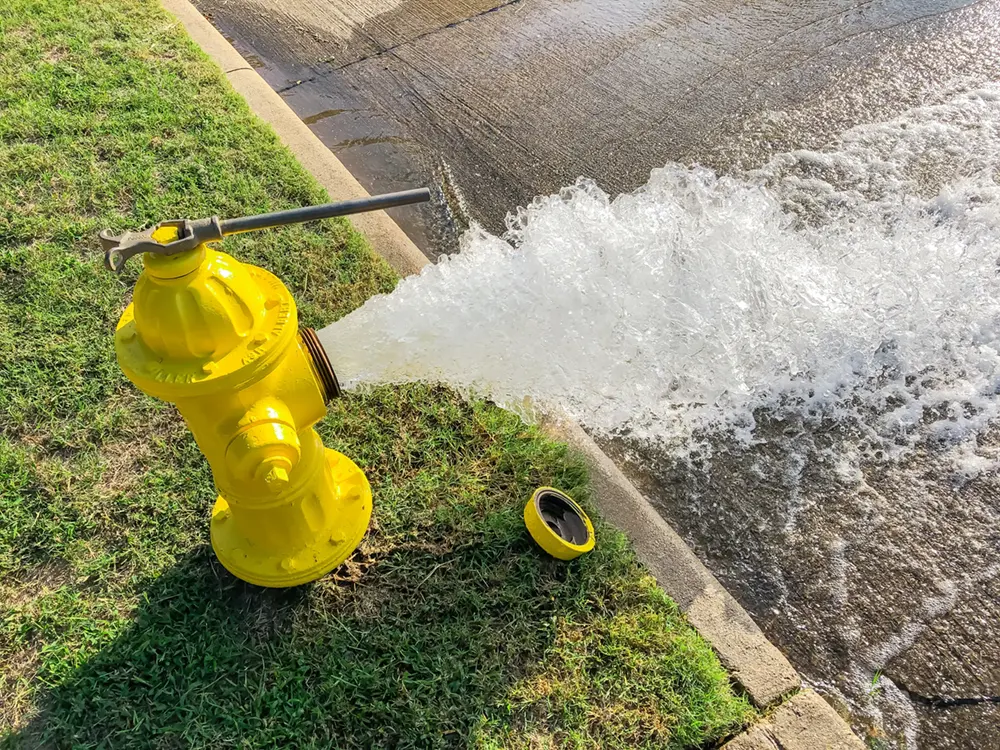

Pressure Control Integration: Don’t bolt it on, build it in
Most distribution systems need some form of pressure control integration to reduce the risk of high pressure causing leaks or low pressure limiting service.
But you shouldn’t have to assemble pressure control piecemeal by sourcing parts from several vendors, then field-building piece by piece. Flowpoint’s turnkey, engineered-to-order pressure management systems are factory-built and arrive fully assembled and performance-tested.
Whether you’re standing up a bulk water system, balancing zones in a distribution network, or stabilizing a new subdivision, Flowpoint will provide you with the means to integrate pressure control into the bigger picture and help you remember you’re not stuck managing it in isolation.
As a result, you get an engineered, assembled, and tested system under one roof. This fully integrated pressure control system installs quickly and performs from day one. It often reduces project timelines from years to months.
Why does Pressure Control Integration matter?
When you need a design that will integrate pressure control, it isn’t just about convenience; it’s about system longevity. Uncontrolled pressure accelerates wear, increases energy use, and shortens system life.
- Over-pressure systems drive more leaks and faster wear. For example, downhill zones are prone to damaging overpressure, which can lead to blowouts and water loss.
- Under-pressure systems force pumps to run longer, increasing energy consumption and maintenance frequency. For example, in uphill neighborhoods or facilities, low-pressure events can cut service and overwork pumps.
Predictive modeling confirms that steady, optimized pressure lowers both energy use and leak frequency across the network. Pressure management protects both infrastructure and budgets. It’s one of the fastest, most cost-effective ways to reduce non-revenue water and extend asset life.
Flowpoint engineers for every pressure point.
No matter the challenge, from climbing elevations in a mountain town to balancing flow between utilities, Flowpoint designs every solution with site-specific pressure control integration.
Whether it’s a booster, reducing, sustaining, or master meter station, every project starts the same way: with a deep dive into your site and system.
Altogether, we look at:
- Your system requirements
- Source water conditions
- Elevation profile
- Flow rates (min/max/average)
- Desired pressure ranges
- Pressure zones and gradients, for potential pressure limiting service
- Redundancy requirements
- Site limitations, such as electrical service limits, power backups, transfer switches, security, and exterior design
From there, engineers model the system’s performance and cost impact before building a single part.
We design each system holistically, modeling pumps, valves, and control logic as a single package to integrate pressure control. Every component — from the PRV pilot to the SCADA interface — communicates seamlessly. Flowpoint can also meet existing utility standards by integrating customer-specified valve brands, PLC platforms, and pressure-control communication protocols.
The result is a modular, engineered-to-order system fabricated and tested under controlled conditions, then shipped fully assembled. On arrival, it drops into place, ready to start up.
How it works: Types of Pressure Control Integration
Although every system faces its own pressure challenges, Flowpoint designs around them, integrating each type of control into the larger water distribution system. The following is a brief description of the types of pressure control included in most distribution systems.
Pressure Reducing Valve (PRV)
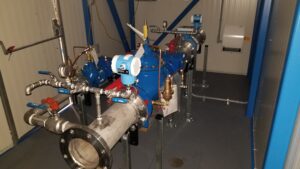
- What it does. Protects downstream systems by lowering high inlet pressure to a controlled outlet pressure.
- Why it matters. Reduces leaks, protects infrastructure, and ensures consistent service across zones—especially those with pressure-limited service requirements.
- Common uses. Transmission-to-distribution transitions, district metered area (DMA) boundaries, integration with bulk water fill stations, and low-elevation areas requiring pressure control limiting service.
Pressure Sustaining Valve (PSV)
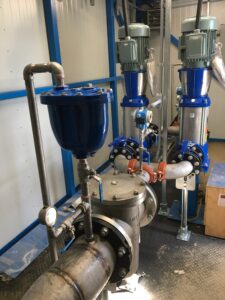
- What it does. Maintains minimum upstream pressure to protect supply mains and pumps.
- Why it matters. Keeps upstream zones and equipment from losing pressure during peak demand.
- Common uses. Pump discharge lines, reservoir outlets, and multi-zone transmission mains.
Altitude Valve (or Fill Tank Control Valve)
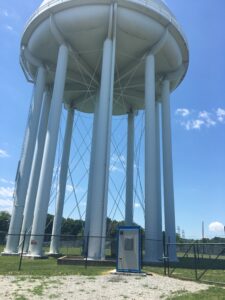
- What it does. Automatically regulates tank filling and prevents overflow without requiring external power or continuous operator input.
- Why it matters. Protects storage assets, maintains hydraulic balance, and ensures available fire flow capacity.
- Common uses. Elevated tanks, storage reservoirs, fire protection systems/refill timing, and booster-fed systems.
System Monitoring and Flow Measurement
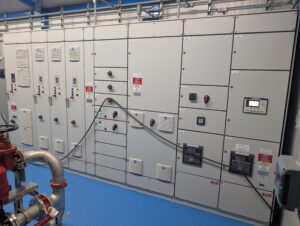
Pressure control integration means nothing, especially without visibility.
Flowpoint’s master meter stations measure and report what’s happening inside your network. Master meter stations give you the visibility to:
- Record total flow between pressure zones or between utilities.
- Monitor system performance, detect leaks, and verify billing accuracy.
- Integrate directly into municipal SCADA systems for real-time decision-making.
Why does Flowpoint’s plug-and-perform engineering pay off?
Traditional construction can take months of onsite work. Multiple contractors built the station. Crews pour concrete, build masonry enclosures, wire controls, and test each component in the field.
Compared to other solutions, Flowpoint simplifies this with a single purchase order and a single project partner.
Each station arrives complete, with pumps, valves, sensors, and controls already installed and factory-tested, ready to be set on the pad and connected to power and piping. Flowpoint hydrostatically and electrically tests each station at the factory, so field commissioning takes hours, not days.
Compared to traditional brick-and-mortar pump houses, this approach:
- Cuts field deployment time by 40-60%
- Improves QA/QC through factory testing
- Reduces installation risk and site labor complexity – no more piecing together components from multiple vendors in the field.
Additionally, we have a wide range of exterior options. Stations can feature brick, stone, or color-matched panels that blend with community architecture while maintaining full performance. So that pressure-control integration isn’t just mechanical; it’s also aesthetic.
Built-in Accountability
Today’s water networks must withstand more than routine operation. In reality, power outages, droughts, and other emergencies test resilience daily across North America.
Flowpoint designs its pressure control stations to both maintain stability under stress and recover quickly after planned and unplanned events alike. Each unit supports:
- Rapid shutdown and restart
- Load-shifting logic
- Backup-power integration
Likewise, Flowpoint backs every system with Five-Nines uptime (99.999%) and a five-year parts warranty.
When emergencies strike, pressure-driven simulations help you prioritize supply, maintain critical service, and protect assets.
Entirely built under one roof, customers have a single point of accountability: one supplier, one warranty, one service partner. This single-source model streamlines procurement and simplifies long-term budgeting.
Get full pressure control integration.
Too often, we don’t think to integrate pressure control and leave it until the end, after we’ve installed pumps and buried pipelines.
Flowpoint delivers an integrated, engineered-to-order pressure control system that includes everything. You can rest assured that it is not only the station but also from the PRV through to the PLC.
Don’t just get pressure control. You deserve an integrated plug-and-play system.
Flowpoint Environmental Systems is the water and wastewater expert for municipalities, utilities, industries, private developers, and remote facilities. Talk to our team about where integrated pressure control could accelerate your next project and eliminate your biggest risk factors. Our engineers can model a pressure control system that pays for itself due to faster installation timelines, reduced water losses, lower energy consumption, and fewer field failures.