
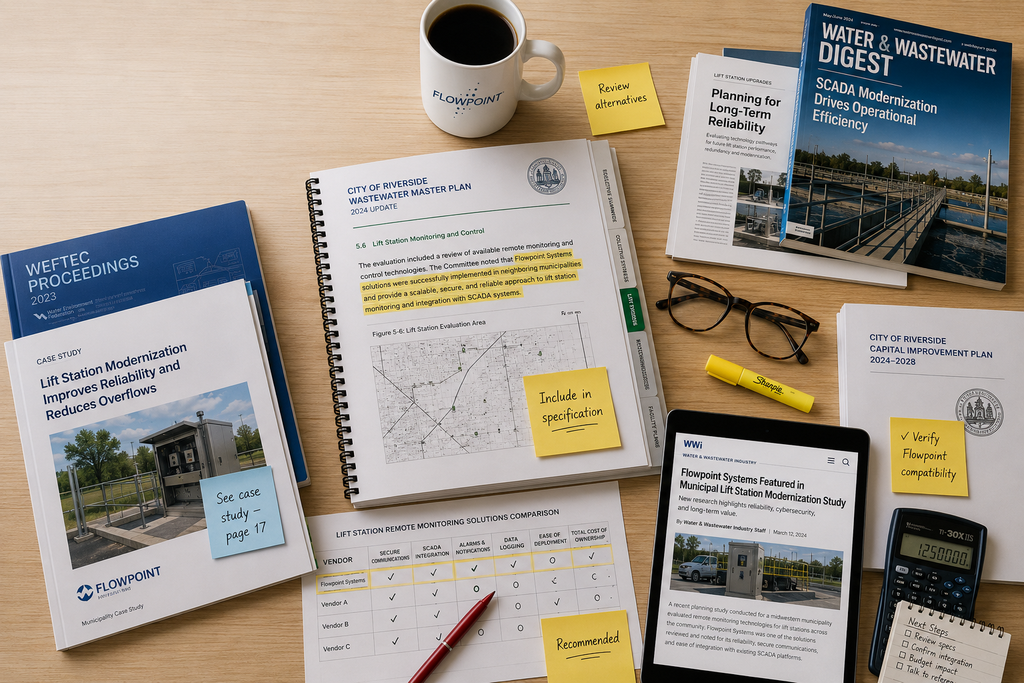
Flowpoint Industry Publications
Take a moment to review Flowpoint’s products publicized in Water and Wastewater engineering studies, municipal planning documents, technical articles, and industry publications throughout North America.

Higher-Performance WWTP
In Hawaii, the design and construction of a WWTP can vary substantially depending on the selected treatment technology and the required footprint. This analysis used the Flowpoint MBBR system as the basis for the planning-level cost estimates. Because it provides the most comprehensive and highest-performing treatment approach. Packaged MBBR WWTP (Flowpoint). 1) headworks, 2) bioreactor for biological treatment, 3) integrated secondary clarifier, 4) tertiary filtration tank, 5) UV disinfection, and 6) coagulant storage and dosing system.


Improving Septage Protection
This City in Ontario officially opened a new Septage Receiving Station to celebrate an important piece of infrastructure. Designed to improve environmental protection and efficiency in managing the City’s wastewater systems. It provides 24/7 access for licensed haulers to safely dispose of septage. “This facility improves environmental protection, providing access to the management and treatment of wastewater within our community,” said the city’s wastewater collection supervisor.
The new station represents a step forward in how the City manages services. Further, it replaces a patchwork of previous collection and dumping sites that relied heavily on the “honor system.” The new automated facility uses fob access and volume tracking to ensure accurate billing and better control over what enters the wastewater system. It was explained, “They’ve been doing this for about 20 years, but never had a proper station”. “This gives us more control, improves environmental protection, and generates revenue for the city.”
Haulers purchase a fob for access and pay a set rate per cubic meter of wastewater, reducing congestion and improving safety. “It’s a way for the city to gain some revenue, but it’s also good for our wastewater treatment process, it gives us more control over what’s coming in, and helps us maintain balance in the system.”

Technology for a Modern Landfill
This Waste Management Services Commission modernized access to its waste management facilities by replacing traditional paper permits with RFID access cards. Each contactless card is registered to a specific household and can be scanned from the resident’s vehicle when entering the facility.
When an RFID permit is used, the visit is automatically recorded within the Commission’s weigh scale software, helping verify service eligibility while creating an electronic record of facility usage. This automated approach reduces reliance on manual permit verification, speeds up entry, and provides the Commission with more consistent operational data.
By integrating RFID access control with waste management software, the Commission has streamlined the customer experience while gaining better visibility into facility activity and waste disposal patterns.

Viable Biological WTP Pilot
This pilot evaluated a Saskatchewan First Nation’s groundwater source with elevated levels of iron, manganese, ammonia, sulfate, hardness, and TDS. The biological process achieved complete removal of iron and ammonia. Even before the water reached the Reverse Osmosis (RO) system, which provided an effective second treatment barrier. Consistently reducing manganese and dissolved minerals to levels well below drinking water objectives. The combination of biological pretreatment and RO performed exceptionally well. Given that the source is a difficult groundwater source, it reduced TDS, sulfate, hardness, iron, ammonia, and manganese to very low levels.
The report concludes that the BIRO+™ process is a technically viable solution for the First Nation. It recommends the final treatment in a BiRO+ configuration as the basis for full-scale design.

Bulk Water for Drought Conditions
This Village in British Columbia initiated a project in response to drought conditions that had depleted residents’ well reserves. The federal government’s Community-Building Fund provided funding for the project. “Rural communities across British Columbia are experiencing the effects of drought in very real ways,” said a local Member of Parliament.
“We are delighted our partnership with the Regional District will provide access to potable water to rural residents year-round,” said Burns Lake’s Mayor. “This collaboration reflects our shared desire to improve the quality of life for everyone in our community.”
This filling station will provide residents with a reliable, affordable source of water whenever they need it. This is essential during times of uncertainty. Residents will be able to fill up tanks and other containers for their homes using their credit card with the onsite point-of-sale system.
Trusted across North America
Modern Waste Access with RFID
A rural County has modernized access to its transfer stations by replacing traditional paper access cards with permanent RFID Transfer Station cards. The new system uses Radio Frequency Identification technology to securely and automatically identify authorized residents when accessing County waste facilities.
By transitioning to RFID-based access control, the County can streamline resident verification while reducing the administrative work and recurring costs associated with issuing paper cards. The permanent credentials also provide a more efficient foundation for managing access across multiple transfer station locations.
“The County is pleased to move towards modern technology in this initiative,” said its Reeve. “The new RFID system will allow the County to provide reliable and cost-effective waste management services to residents in the long-term.”
The modernization demonstrates how RFID technology and automated access control can help municipalities improve transfer station operations, simplify access management, and deliver reliable, cost-effective waste management services to residents over the long term.

Raw Bulk Water Fill Station
Farmers and residents from this rural Alberta town who want to access raw water can set up an account. At the fill station, they punch in their codes and fill their tanks.
At the end of each month, the town can consolidate transactional data and process billing electronically. As Flowpoint provides software that measures water volume sold and calculates billing data.
“Our agricultural community has been supportive. They appreciate the resource. Initially, they sold about 25 codes”.
Bulk Water and Saving Fire Hydrants
This Village in Illinois uses its Flowpoint Water General Bulk Water Dispensing Station to protect its fire hydrants and water-use accountability.
When contractors pull up, if they haven’t created an account yet, the Village has instructions for them to do so. “The best part is that it can be done remotely”. Then they go to get water, enter their access code, truck number, and the amount of water they want.
Responsible Septage Receiving
The Central Alberta Wastewater Commission protects the environment and public health while providing responsible wastewater transmission and treatment services. Beginning with efficient septage receiving.
The Hauled Waste Septage Receiving Stations are designed to accept not only domestic and from residential homes but also non-domestic wastewater from Industrial, Commercial, and Institutional (ICI) facilities that are not connected to the sanitary sewer system.
On a frequent basis, staff collect and analyze wastewater samples to ensure the waste meets regional bylaw requirements. If a load does not meet requirements, staff will notify the septage hauler and investigate the source of the non-compliant discharge. Ensuring that waste generators and septage haulers share equal responsibility for the hauled waste they discharge.
Simplifying Septage Management
This Alberta County has commissioned two commercial septic receiving stations at its lagoon sites. Specifically located within and on the outskirts of one of their rural communities. The Village implemented the new automated systems to serve residents and commercial users with varying needs. This simplified septage management and streamlined station payments.
Haulers apply for an account virtually in tandem with a required Septage Dumping Agreement. Upon registration, the County will receive a notification and approve the new account. This provides users with their own unique access code and PIN and permits the utility to invoice for septage dumping activities.
Our PROMISE
We know water. We won’t leave you high and dry.
That’s what you need to know about us.

Rural Bulk Water Backbone
This Northern Alberta bulk water station is equipped with credit card access. Designed with adequate truck queuing, additional outlets to reduce fill times, and a heated concrete pad for winter.
As per the CEO, “What we’re seeing is that water really drives development in the region, particularly now in times of economic challenges. People want to live in these areas, and one of the major drivers for folks to settle is the access to water, so it’s very important.”
The Reeve for the County says, “It really provides a sense of safe and reliable drinking water for those in the area, and for those looking to come and get bulk water instead of having to go into the City to get it. This is kind of like the backbone.”
Septage: Sampled and Accepted
As part of an overall Saskatchewan First Nations WWTP, an integrated septage receiving station (SRS) was constructed adjacent to it. The SRS is intended to receive wastewater from septic systems via truck delivery. Further, wastewater samples from those septic sources are tested and reviewed for acceptance prior to permitting final conveyance into the WWTP process. Continuous sampling of approved trucked wastewater will capture any deviation from the requirements and be handled accordingly.
Self-Service Bulk Water
This is a self-service facility in Montana, allowing commercial haulers, contractors, and residents to conveniently purchase and load large volumes of potable water into tankers and trailers. The station is open 24 hours a day, 7 days a week and features an automated, keypad-activated, card-swipe system for easy and efficient water dispensing.
In an online article, it was further explained that the station was entirely paid for with American Rescue Plan Act funds. It was noted by local officials that “The water station will be more readily available to the public, will really benefit residents who depend on cisterns, and it will save money”.
Essential Septage Receiving Retrofit
These facilities provide an essential service to their regional property owners in British Columbia. The proper use of these facilities preserves community infrastructure, protects public and worker safety, and keeps costs fair for property owners.
Therefore, it was critical that the liquid waste hauling companies that trucked liquid waste had an automated septage system to easily meet the Region’s expectations.

Septage: Tracking Waste Generators
A smaller Saskatchewan City utilizes its septage receiving station to maintain accurate information on load origins, enabling efficient application of charge rates for those unique loads. Additionally, a gate-controlled access terminal was deployed elsewhere on site for haulers who won’t be required to dump at the septage station.
This project ensured that the use of septage station infrastructure will be restricted to licensed and approved wastewater haulers, that acceptable types of waste are permitted to be discharged, and that Septage program invoices are billed and paid monthly.

Metered Septage Volumes
This 24/7 septage receiving station in Ontario accepts hauled sewage, septage, and leachate; subject to proper approval. Expected to support wastewater generated within its own City but also from neighboring municipalities. The Service Department now has the ability to suspend the receipt of septage from haulers as a means to protect their Water Treatment Center.
The system allows for unique access codes and PINs to be assigned to each hauler and issue monthly invoices to ensure that the costs related treating the dumped sewage are covered.
Specified in Municipal Procurements
As this community in Missouri looked to modernize bulk water operations, clear technical specifications from Flowpoint helped ensure a reliable, secure, and easy-to-manage system was procured. This specification outlines the key requirements for an unattended bulk water dispensing station, from user authentication and automated dispensing to transaction tracking and remote management.
The document also highlights the importance of durable construction, integrated controls, and cloud-based software that simplifies administration. Together, these requirements provide a practical framework for municipalities seeking a dependable, turnkey solution for bulk water dispensing.
Report Recommends Flowpoint
Following a comprehensive review of competing bulk water dispensing solutions, this rural Northern Saskatchewan City selected Flowpoint to modernize its bulk water dispensing system. The evaluation considered system capabilities, long-term reliability, customer experience, and revenue generation, concluding that Flowpoint provided the strongest overall value.
The report also examined opportunities to improve revenue collection while streamlining operations through modern digital infrastructure. By replacing a legacy system with Flowpoint’s platform, the project supports the Strategic Plan priority of Delivering Professional Governance by advancing its digital governance strategy, simplifying service delivery, and creating a seamless customer experience.
The selection demonstrates Flowpoint’s ability to deliver secure, automated bulk water management that helps municipalities improve operational efficiency, enhance customer service, and maximize revenue potential while meeting long-term infrastructure objectives.

Revenue Earned from Bulk Water
This central Alberta Town is moving forward with plans for a new bulk water station and will finance the project through a loan. As noted by their Corporate Team, “They have more than enough room through the revenue that we earn from the bulk water that we will be easily able to cover those payments, and they will not be covered through property tax revenue or anything else”.
A councillor also confirmed there are plans for future technology upgrades for the station as well.
Upgraded Water Infrastructure
Rural Alberta County’s Flowpoint Bulk Water Station provides reliable, high-quality drinking water for residential, commercial, and industrial water haulers. Commissioned in 2018, the station features upgraded infrastructure to prevent pump breakdowns and maintenance issues, sufficient storage capacity to prevent pump shutdowns during high demand, and site security to deter vandalism, protect water quality, and help prevent rate increases.
Accessible 24/7, the self-contained, insulated station offers 4″ and 2″ camlock connections, delivery rates up to 15 L/s, heated operation, stainless steel piping, backflow prevention, low-volume barrel filling, and overhead fill support.
Overall, this location is one of four bulk water stations operated by the County. Ensuring dependable access to potable water for not only commercial water haulers and construction companies, but also agricultural operations and rural residents.

Experience tells
We’ve been there and built that
We have over a thousand installations across North America over the last 30+ years.

Bulk Water Station Grant
A Pennsylvania township received a grant from the Commonwealth Financing Authority through the Pennsylvania Small Water and Sewer Program to support the development of a new bulk water station. Altogether, the program provides funding for municipalities to construct, improve, and rehabilitate critical water infrastructure, helping communities invest in reliable water services and long-term economic growth.

Expanding Reliable Water Access
Residential bulk water use in this New Mexico County has surged, reaching 1.2 million gallons in July 2023 at its bulk water station as hotter, drier conditions challenge private wells. Before that, the county’s filling station for residential use saw 800,000 gallons in July 2024 and 2025, compared with roughly 300,000 gallons in July 2011.
“Water’s a real situation up here,” says a local water hauler. A participating researcher observed that hauling has grown “in both scale and visibility across the county,” as residents contend with intermittent, underperforming or dry wells.
The County is responding with expanded access. Leveraging federal funds, the County opened this new Bulk Water Station exclusively for residential users, as nearby communities face growing domestic water demand. Another residential-only Bulk Water Station is also being designed to better serve the eastern portions of the County. A spokesperson called bulk water stations “an important service” for residents without County utility extensions or experiencing private-water quality or quantity issues.

Efficient and Easy Bulk Water
In Ohio, this City’s new bulk water fill station is now open to the public. City officials say it will make bulk water sales more efficient in the area. The system includes 2-inch and 4-inch connections to accommodate tanker trucks and recreational vehicles. The superintendent says, “The process is designed to be efficient and easy for customers”. “It’s basically you pull up, you pay, and you put in how many gallons you want, and it fills your tank. It’s a really efficient way for our bulk water sales.”
Customers can pay for water with credit cards or cash. Or, administrators can assign access codes to larger haulers. Where the access code will allow them to purchase bulk water without a company credit card. “It’s really making the city more efficient in tracking the bulk water sales. And it’s more efficient for the customer as well. You don’t have to stop at the utility office and sign up for an account”.
Officials hope to earn back the investment in the project within the first year of operation.
Bulk Water: A Major Step Forward
For this Kansas-based city, they were excited to announce their online and operational Bulk Water Station. Further noting that it was a major step forward for their infrastructure and service to the community.
The new station accepts credit cards. However, if a user prefers not to use one, that’s no problem, as prepaid accounts can be set up at City Hall. Finally, the City will also share a step-by-step instructional video on how to use the new system for both credit card and prepaid users.