
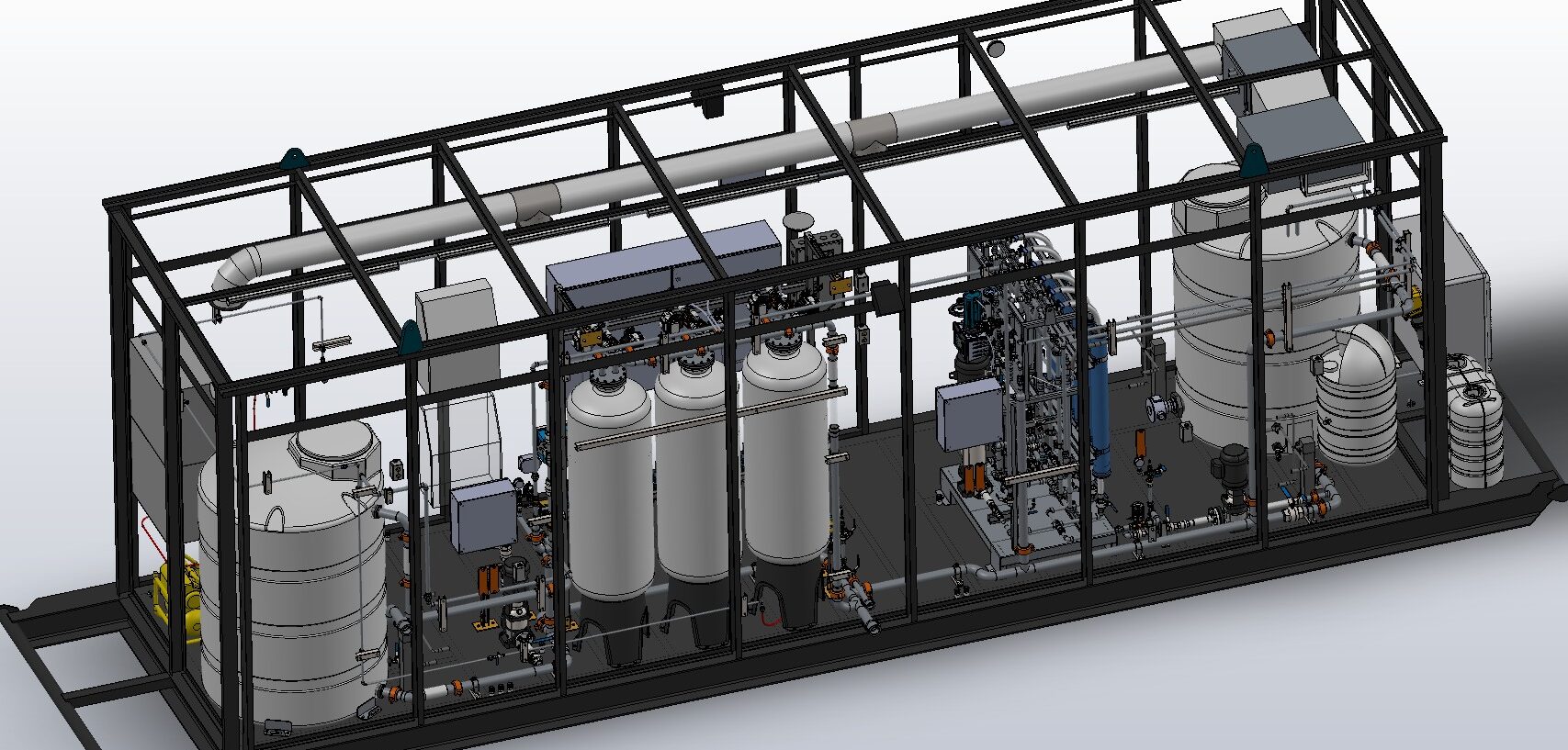
BiRO+ Groundwater Treatment Pilot
First Nations, Rural Utility, Saskatchewan
Application
Groundwater treatment pilot, with biological filtration, for a rural drinking water system serving hundreds of homes passed
Field-Validation
Integrated biological filtration water treatment and reverse osmosis process
Pilot Flow
Final biological filtration operating rate of 0.24 L/s (3.8 US GPM)
Treatment Process
Biological filters with reverse osmosis and remineralization for a full-scale groundwater treatment system
Complementary Stages
Divided treatment between complementary process stages, providing for contaminant removal from groundwater
Long Term Solution
Validating a Treatment Pilot for Challenging Groundwater Sources
A Rural Utility required a long-term approach to treating a groundwater source with multiple water-quality challenges, rather than only solving for a single, isolated contaminant removal process. The Rural Utility’s existing water treatment infrastructure was approaching the end of its expected service life, creating an opportunity to evaluate a treatment pilot to address both current groundwater conditions and the community’s long-term drinking water requirements.
Flowpoint worked with the project’s engineering consultant to propose its BiRO+ biological water filtration and reverse osmosis process, then conducted a field pilot to demonstrate its groundwater treatment performance before the project decided upon a permanent full-scale design.
The pilot had a clear objective: to demonstrate that the integrated process could reliably treat the existing groundwater source while establishing the operating parameters required for a permanent water treatment facility serving hundreds of homes. The pilot system was specifically designed and manufactured for the project as a scaled representation of the proposed full-scale groundwater treatment process.

The Challenge
Groundwater treatment becomes considerably more complex when multiple parameters require different treatment mechanisms.
The Rural Utility’s raw-water testing identified concentrations including iron above 1 mg/L, manganese around 0.3 mg/L, ammonia approaching 3 mg/L in the initial source-water information, total dissolved solids approaching 1,500 mg/L, hardness exceeding 800 mg/L, and sulfate around 690 mg/L. During subsequent operation, some parameters fluctuated even further, including ammonia concentrations at approximately 5 mg/L.
No single treatment stage was expected to address everything efficiently.
Initially, the biological groundwater treatment effectively removed iron and ammonia. However, dissolved minerals such as sulphate and most of the total dissolved solids required membrane treatment.
Manganese presented another consideration: biological removal of manganese contaminants can require an extended period for the necessary bacterial population to mature and treat the groundwater.
The pilot therefore needed to answer more than whether BiRO+ could produce acceptable water.
It also needed to determine how the individual treatment stages would complement one another, how operating conditions would affect biological performance, and whether the downstream reverse osmosis membranes could remain stable when treating biologically filtered groundwater.

The Solution
Flowpoint developed and manufactured a dedicated BiRO+ pilot system as a scaled representation of the proposed groundwater treatment process.
The system combined biological filtration with compressed-air and oxygen injection, followed by cartridge filtration and pressurized reverse-osmosis membranes. The equipment was factory-installed inside a heated and ventilated modular enclosure before being transported to the Rural Utility’s site. Rather than relying on reverse osmosis for the entire treatment, BiRO+ divided the process into two complementary stages.
Biological water filtration served as the primary treatment barrier for iron and ammonia.
Raw groundwater passed through a series of biofilters that promoted the natural growth of microorganisms under controlled oxygen and hydraulic conditions. As the biological process matured, the filters oxidized and removed iron while nitrifying ammonia.
Reverse osmosis served as the second treatment barrier.
After biological treatment, the groundwater passed through the membrane treatment system. This stage was designed to remove dissolved constituents that biofiltration could not practically address while also providing secondary protection against residual iron, ammonia and manganese. This staged approach was particularly important for a groundwater source containing both biologically treatable contaminants and high concentrations of dissolved minerals.
Full-Scale Process
Optimizing the Process Under Field Conditions
The groundwater treatment pilot was started in fall 2025 and remained in the field until mid-April 2026. During that period, the team evaluated three different biofiltration operating scenarios. The first two scenarios intentionally explored operating conditions that could potentially reduce capital or operating costs.
Higher flow rates could theoretically reduce the size of the required filtration vessels. Lower operating pressures could reduce energy and motor requirements. The pilot provided an opportunity to determine whether those potential efficiencies could be achieved without sacrificing treatment reliability. They could not.
The first operating scenario produced effective groundwater contaminant removal. Iron removal occurred relatively quickly, but ammonia removal remained inconsistent, and manganese removal was minimal. Increasing operating pressure during the second scenario improved both iron and ammonia performance, but treatment still did not consistently reach the desired objectives.
The trials provided valuable information nonetheless. Instead of simply demonstrating that the technology worked under favorable conditions, the pilot helped establish the process’s operating limits and identify which configuration offered the best balance of performance and reliability.
Establishing the Preferred Treatment Configuration
For Scenario III, the feed-water flow rate was reduced, and operating conditions were brought closer to Flowpoint’s standard design parameters. The change created more favorable conditions for biological activity. Iron removal remained effective, with essentially no iron detected after the first filtration stage. Approximately one week after the operating change, ammonia removal reached the desired performance and eventually stabilized at complete removal through biofiltration. The pilot had identified the preferred configuration for the proposed full-scale process.
reduce contaminant loading
Biological Groundwater Treatment as the First Barrier
The biological stage demonstrated one of the central principles behind the BiRO+ process: contaminants that can be efficiently removed biologically do not need to become a membrane-treatment problem. Under the final operating configuration, biofiltration completely removed iron and ammonia before the water entered the reverse osmosis system. That distinction matters.
Removing iron upstream reduces the contaminant loading placed on the membranes and decreases one potential source of membrane fouling. The RO system then remains available as a secondary treatment barrier if biological breakthrough or a process upset ever occurs. The treatment field study found no evidence of significant membrane fouling or scaling from the groundwater during the pilot program. Biological pretreatment produced water suitable for stable membrane operation, supporting the use of the combined process rather than relying on membrane treatment alone.
Best Suited Technology
Reverse Osmosis as the Second Barrier
While biological filtration primarily treated iron and ammonia, reverse osmosis addressed the secondary treatment of dissolved constituents remaining in the water. The membranes consistently reduced manganese to at or below the required drinking water objectives despite limited biological manganese removal during the pilot period.
They also substantially reduced total dissolved solids, sulfate and hardness. Testing near the conclusion of the pilot illustrates the division of work between the two treatment stages. Raw groundwater containing approximately 1,520 mg/L of total dissolved solids reached the RO system at approximately 1,510 mg/L after biofiltration because dissolved mineral contaminant removal was not the purpose of the biological treatment process.
RO treatment reduced that concentration to approximately 41 mg/L. Similarly, sulfate was reduced from approximately 690 mg/L in the raw water to 13 mg/L after membrane treatment, while hardness was reduced from approximately 814 mg/L to 16 mg/L. This allowed each treatment technology to perform the work for which it was best suited.
Proven Groundwater Contaminant Removal Performance
Across the pilot program, the integrated BiRO+ process achieved substantial reductions in the principal parameters of concern. The final configuration consistently produced treated water meeting the applicable aesthetic and health-based drinking water objectives identified for the project.
Iron
Raw Water: Up to 2.05 mg/L
Treated Water: < 0.01 mg/L
Reduction: >99%
Ammonia-N
Raw Water: Up to 24.98 mg/L
Treated Water: < 0.01 mg/L
Reduction: >99%
Sulfate
Raw Water: Up to 791 mg/L
Treated Water: ~ 13 mg/L
Reduction: >98%
Total Dissolved Solids
Raw Water: Up to 1,550 mg/L
Treated Water: ~ 41 mg/L
Reduction: >97%
Hardness as CaCO₃
Raw Water: Up to 876 mg/L
Treated Water: < 16 mg/L
Reduction: >97%
Manganese
Raw Water: Up to 0.34 mg/L
Treated Water: < 0.01 mg/L
Reduction: >98%
Total Organic Carbon
Raw Water: Up to 4.2 mg/L
Treated Water: < 0.1 mg/L
Reduction: >97%
Dissolved Organic Carbon
Raw Water: Up to 4.2 mg/L
Treated Water: < 0.1 mg/L
Reduction: >97%
Valuable Field Testing
Field Conditions Became Part of the Test
Pilot testing also exposed the treatment system to conditions that are difficult to mimic in a controlled laboratory environment. The program experienced multiple power interruptions. Extreme winter conditions led to a heating system failure and a freezing event. The biological filters subsequently required recovery and reseeding. Those interruptions affected bacterial development and extended the time required for the biological process to stabilize.
They also provided valuable operational information. Following the freezing event, iron-removal performance recovered within approximately three days, while ammonia treatment recovered to approximately 90% in less than three weeks during the second operating scenario. By the final scenario, the biological treatment process had developed sufficiently to achieve the required removal of iron and ammonia consistently from the groundwater.
The field program therefore demonstrated not only treatment performance but also how the biological system responded to interruption, recovery and changing source-water conditions.
More Than a Single Process
Understanding Biological Manganese Removal
Manganese produced a different result during the pilot. Although the biological filters were designed to contribute to manganese treatment, a mature population of manganese-oxidizing bacteria generally develops only after stable ammonia removal has been established and may require an extended operating period.
Because stable ammonia removal was achieved later in the pilot, the field study concluded before sufficient biological manganese removal performance had developed. The integrated treatment strategy ensured that this did not prevent the system from meeting its water-quality objective.
Reverse osmosis consistently reduced manganese to concentrations below both the applicable maximum acceptable concentration and the aesthetic objective, providing a reliable second barrier. At the same time, biological maturation continues in a future full-scale system. This redundancy is an important feature of the treatment approach: performance does not depend on every contaminant being completely removed by a single process.
Reliable Technology
From Pilot Testing to Full-Scale Design
The value of pilot testing extends beyond proving whether a technology can treat water. It establishes the conditions under which that technology performs reliably. For the Rural Utility, the program tested operating pressures, hydraulic loading, biological development, membrane performance, backwashing requirements and system recovery under actual field conditions.
The results ultimately supported Scenario III as the basis for full-scale treatment design. Flowpoint’s recommended configuration combines biological iron and ammonia removal, reverse osmosis treatment, post-treatment remineralization and operational redundancy measures. The report concluded that a full-scale BiRO+ system can be effectively deployed for the Rural Utility and can produce water within the applicable Drinking Water Guideline limits and ranges.
The Final Result
The Rural Utility’s pilot demonstrated that a difficult groundwater source containing several different treatment challenges could be addressed through a single integrated treatment strategy. Biological water filtration removed iron and ammonia before they reached the secondary treatment membranes. Reverse osmosis substantially reduced manganese, sulfate, hardness, total dissolved solids and other dissolved constituents.
The membrane system remained stable, with no evidence of significant fouling or scaling. Field testing established the operating conditions needed to move from a pilot-scale system toward full-scale implementation. Most importantly, the project transformed a proposed treatment concept into a process validated under real operating conditions. The result provides the Rural Utility and its engineering team with a technical basis for the detailed design of a permanent treatment facility that requires a proven groundwater contaminant removal process.
Combining Complementary Processes
More Than a Successful Groundwater Treatment Pilot
This Rural Utility’s project demonstrates an important principle in treating complex groundwater: the objective should not be to force one technology to solve every water-quality problem. Effective treatment can instead come from combining processes that perform complementary functions.
For BiRO+, biological treatment addresses contaminants such as iron and ammonia before they reach the membrane system. Reverse osmosis then provides an additional treatment barrier, removing dissolved constituents from the water beyond the practical scope of biological filtration. The pilot also showed why field validation matters.
Alternative operating conditions that appeared capable of reducing capital or operating costs did not provide sufficiently consistent biological performance. Testing those approaches before proceeding to full-scale design allowed the project team to establish operating parameters based on demonstrated treatment reliability rather than theoretical efficiency alone.
For communities dealing with challenging groundwater chemistry, that type of validation can provide greater confidence that a proposed treatment process is designed around the actual source water, operating environment and long-term needs of the facility.
Get Started
Need a Groundwater Treatment Solution?
Flowpoint Environmental Systems designs and manufactures engineered water treatment systems for communities facing complex groundwater and drinking-water challenges.
Whether a project involves elevated iron and manganese, ammonia, high dissolved solids, hardness, sulfate or a combination of treatment concerns, pilot testing can help determine the appropriate process before progressing to full-scale implementation.