

Centralized vs Decentralized Water Infrastructure: What Actually Works Today?
For decades, centralized water and wastewater systems have been the foundation of municipal infrastructure. Mostly because large treatment facilities serving entire communities became the standard model, offering economies of scale and a proven approach to delivering reliable services. However, the challenges facing municipalities today are very different from those that shaped infrastructure planning fifty years ago. To address these challenges, engineers developed a new approach: decentralized water infrastructure.
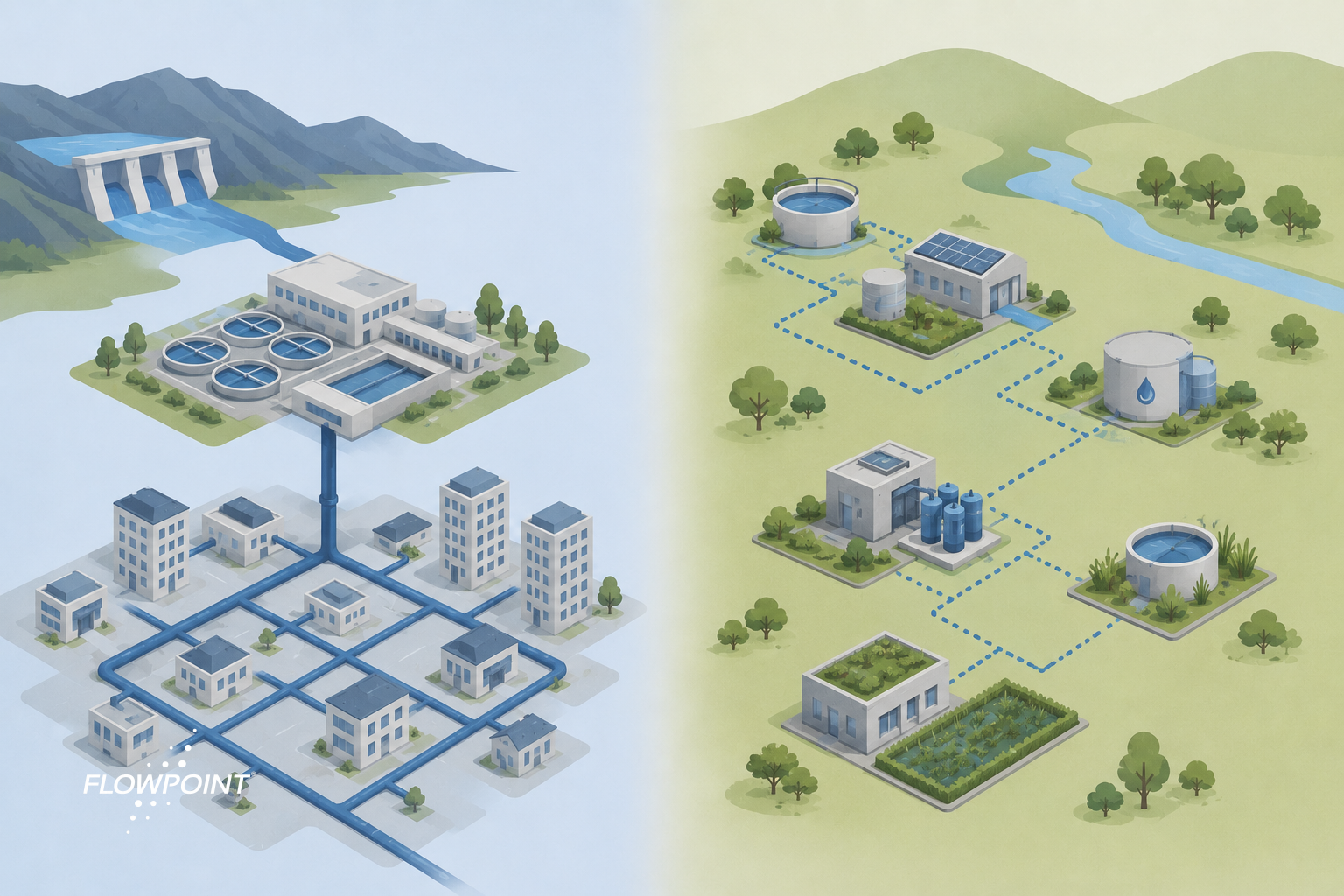
Water system centralization and decentralization have variously been promoted as key to achieving household water security and Sustainable Development – Source
Population growth is becoming less predictable. Development is expanding into previously unserved areas. Regulatory requirements continue to evolve. At the same time, municipalities are under pressure to maximize infrastructure investments while maintaining operational efficiency. As a result, many communities are reconsidering traditional approaches and exploring decentralized alternatives.
The question is no longer whether one model is inherently better than the other. Instead, municipalities are asking a more practical question: What actually works best for our specific needs today and in the future?
Understanding Centralized Water Infrastructure
Centralized water and wastewater systems rely on large treatment facilities that collect, process, and distribute water across extensive service areas. This model has become the industry standard for good reason. Centralized systems offer several advantages:
- High treatment capacity
- Established engineering and operational standards
- Centralized monitoring and management
- Economies of scale for large populations
- Consistent treatment processes
In densely populated urban areas, centralized water infrastructure often remains the most efficient solution. Large treatment plants can process significant volumes of water and wastewater while serving thousands, or even millions, of residents. Many municipalities have invested heavily in these systems over decades, creating infrastructure networks that continue to provide reliable service.
However, centralized systems also present challenges. Expanding capacity often requires substantial capital investment. New treatment facilities, lift stations, and pipeline networks can involve years of planning, permitting, and construction. Once built, centralized systems can also be difficult to modify. Infrastructure decisions made today may need to serve communities for decades, making flexibility a significant consideration.
What Is Decentralized Water Infrastructure?
Decentralized water infrastructure takes a different approach. Communities can treat water closer to where they use it and process wastewater closer to where they generate it, rather than relying on a single large treatment facility. This can include:
- Community-scale treatment systems
- Modular wastewater treatment plants
- Satellite treatment facilities
- Decentralized wastewater systems for developments
- Regional water treatment hubs
Instead of building one large system to accommodate future growth, municipalities can deploy smaller systems as demand develops. This approach offers several benefits:
- First, decentralized systems enable faster deployment than large, centralized projects. Teams can design, manufacture, and commission modular infrastructure on significantly shorter timelines.
- Second, municipalities can add capacity incrementally. Instead of building excess infrastructure in anticipation of future needs, municipalities can add capacity as growth occurs.
- Third, decentralized systems can reduce the need for extensive pipeline networks, particularly in rural or geographically dispersed areas.
Where Centralized Water Infrastructure Works Best
Despite growing interest in decentralized approaches, centralized infrastructure continues to play an important role. Centralized systems are particularly effective in:
Large Urban Centres
High-density populations benefit from the economies of scale that centralized treatment provides.
Mature Service Areas
Communities with stable populations and established infrastructure networks can continue leveraging existing assets effectively.
High-Volume Applications
Industrial zones and large metropolitan regions often require treatment capacities that are best managed through centralized facilities.
Long-Term Predictability
When growth patterns are well understood, centralized water infrastructure can provide efficient long-term service. In these situations, the scale and efficiency of centralized treatment often outweigh the benefits of flexibility.
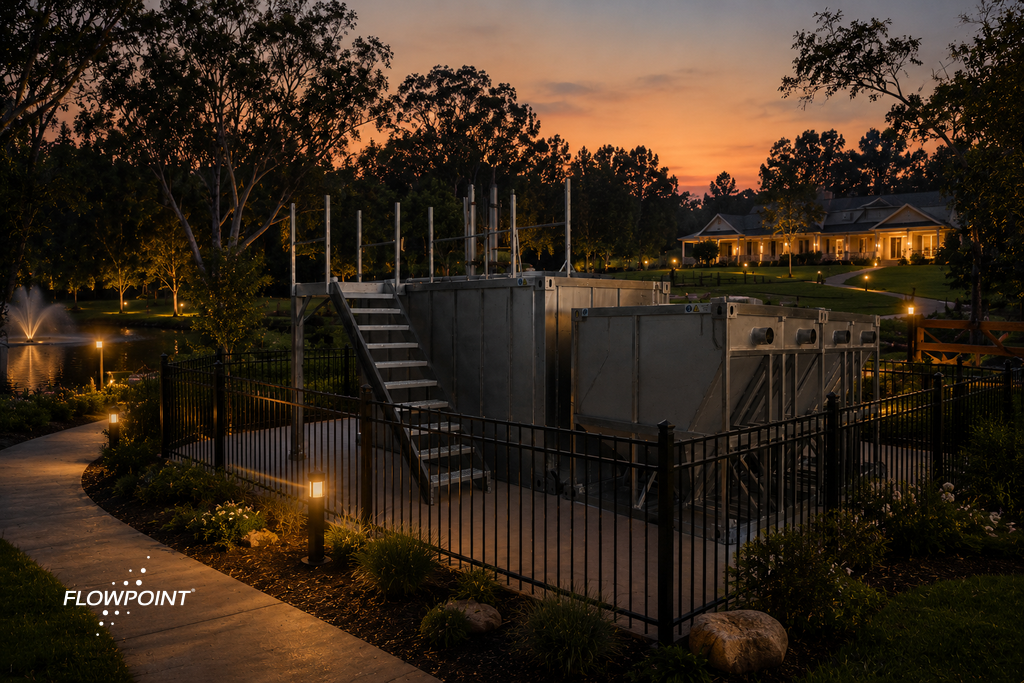
Where Decentralized Systems Add Value
While centralized systems excel in established urban environments, decentralized infrastructure can offer significant advantages in other scenarios.
Growing Communities
Many municipalities are experiencing growth in areas beyond existing service boundaries. Extending centralized infrastructure to support new development can be not only costly but also time-consuming. Decentralized systems provide an alternative that enables growth without waiting for major network expansions.
Rural and Remote Locations
In remote areas, extensive collection and distribution networks may not be economically feasible. Decentralized treatment allows communities to access modern water and wastewater infrastructure without requiring large-scale construction projects.
Phased Development Projects
Developers often face uncertainty regarding buildout schedules and future demand. Modular water infrastructure allows capacity to be added as projects progress, reducing upfront costs and improving flexibility.
Temporary or Transitional Applications
Some projects require infrastructure solutions before permanent systems are constructed. Decentralized systems can provide interim capacity while long-term plans are implemented.

Flexibility Versus Scale
The fundamental difference between centralized and decentralized water infrastructure comes down to priorities. Centralized systems are designed to maximize scale and efficiency. Decentralized systems are designed to maximize flexibility and adaptability. Historically, municipalities often prioritized scale because growth patterns were relatively predictable. Subsequently, communities expanded gradually, and infrastructure could be planned decades in advance.
Today, growth can be far less predictable. Population shifts, economic changes, housing demand, industrial development, and environmental pressures can all alter infrastructure needs more rapidly than in the past. This uncertainty is leading many municipalities to place greater value on flexibility. The ability to expand capacity incrementally, respond to changing conditions, and reduce upfront investment risk has become increasingly attractive.
The Rise of Hybrid Infrastructure Strategies
In practice, many municipalities are discovering that the best solution is not strictly centralized or decentralized. Instead, hybrid infrastructure models are becoming more common. These approaches combine the strengths of both systems. A municipality may maintain centralized treatment capacity within its urban core while deploying decentralized systems to support new developments, remote communities, or specialized applications.
This strategy offers several advantages:
- Improved flexibility
- Reduced infrastructure risk
- Faster project implementation
- More efficient capital allocation
- Better alignment with actual growth patterns
Rather than forcing all development into a single infrastructure model, hybrid approaches allow municipalities to select the most appropriate solution for each situation.

Planning for the Future
Water and wastewater infrastructure investments are among the most significant decisions municipalities make. These systems must support communities for decades while adapting to changing demands, evolving regulations, and uncertain growth patterns. As a result, successful municipal water planning increasingly requires balancing multiple considerations:
- Current service requirements
- Future growth projections
- Capital budgets
- Operational resources
- Regulatory compliance
- Long-term flexibility
Rather than a universal solution, your unique situation presents two feasible options. Centralized systems continue to deliver tremendous value in many applications. Decentralized wastewater systems and modular water infrastructure provide compelling advantages in other areas.
The communities that are planning most effectively for the future are not asking whether centralized or decentralized water infrastructure is better. They are asking which approach best supports their specific goals, challenges, and growth strategies. By understanding the strengths and limitations of each model, municipalities can make informed decisions that deliver reliable service today while maintaining the flexibility needed for tomorrow.