
The Flowpoint Process
Most of our technical blogs focus on the solutions, products, and software Flowpoint provides. Today, we are stepping back to explain the process that Flowpoint follows. Our Turnkey Water and Wastewater Project Delivery approach connects discovery, engineering, manufacturing, programming, testing, training, and long-term service. It brings water and wastewater automation, custom water management software, and hands-on project support into one coordinated water and wastewater design-build process. We call it the Flowpoint Process. Rather than asking customers to manage disconnected vendors, our team works toward one defined solution from the first questions onward. As a result, municipalities, utilities, engineers, developers, and operators gain a clearer view of what will happen, who is responsible, and how the finished system will support their operation.
Every project has its own site, users, budget, and operating demands. So we don’t start with a fixed answer. We begin by listening, defining the need, and identifying the people who must help shape the result.

Discovery Sets the Foundation for Turnkey Water and Wastewater Project Delivery
Strong projects begin with useful questions. During discovery, our team works with the customer to establish key parameters, confirm specifications, and identify project stakeholders. We also discuss how people will use the system each day. As a result, early conversations address both technical requirements and practical operating realities.
Site conditions, expected flows, access requirements, reporting needs, payment methods, existing infrastructure, and future growth can all affect the design. For that reason, the team looks beyond a basic equipment list. This discovery work gives everyone a shared starting point before detailed design begins.
The Flowpoint Process Begins by Listening
The Flowpoint Process allows operators, consultants, owners, and project teams to clarify priorities early. Perhaps the municipality needs unattended access, better transaction records, or a treatment system designed for changing demand. Alternatively, the project may require a compact building, remote monitoring, special controls, or integration with existing systems.
Flowpoint uses these discussions to define the application before proposing the answer. Our water and wastewater engineering and design team can then evaluate the full project rather than one isolated component. In turn, the resulting concept reflects the operation it must serve.
Conceptualize and Test Through a Water and Wastewater Design-Build Process
Once the need is clear, the project moves into concept development. This stage of the water and wastewater design-build process can include 3D drawings, budget estimates, proposal pricing, and revisions based on customer feedback. Instead of waiting until fabrication to uncover a conflict, the team can review the system while changes are still easy to make.
Three-dimensional design helps customers and engineers understand equipment placement, access, service clearances, and the relationship between key components. Meanwhile, virtual review allows the project team to test ideas against the original requirements. The design can evolve before steel is cut, panels are built, or software is programmed.
This approach also helps customers understand what “turnkey” means in practice. A turnkey project should coordinate the physical system, controls, documentation, and user experience. Our article about a modular turnkey station provides another example of how integrated delivery can reduce vendor coordination and simplify implementation.

Finalize the Package Before Production Begins
After the concept meets the project need, Flowpoint prepares the package for approval. Typically, this work includes design approval, the submittals package, shop drawings, and a detailed bill of materials. These deliverables give the customer and consulting team a structured opportunity to review what Flowpoint plans to build.
Clear documentation supports better decisions. It also creates a common reference for procurement, manufacturing, installation, commissioning, and future maintenance. Accordingly, the customer can confirm important details before the project enters production.
The water and wastewater design-build process should not hide critical information between separate suppliers. Instead, engineering, mechanical design, electrical design, controls, and software requirements should support the same approved outcome. That coordination becomes especially important when the final system combines equipment, automation, communications, reporting, and payment functions.
Build and Deliver with Water and Wastewater Automation
Once approvals are complete, Flowpoint moves into production and programming. Our teams manufacture the physical system while software and controls specialists configure how it will operate. Because the work remains coordinated, water and wastewater automation develops alongside the equipment it will control.
Factory Acceptance Testing, commonly called FAT, provides an important checkpoint before delivery. The team tests functions, confirms programming, and checks the assembled system against the approved requirements. If an issue appears, Flowpoint can address it in a controlled factory environment instead of discovering it after the system reaches the site.
The same integrated thinking applies across applications. For example, an automated bulk water management solution must coordinate customer access, flow control, measurement, transactions, reporting, and support. Therefore, effective water and wastewater automation involves more than opening a valve or switching on a pump.
Custom Water Management Software Connects the Operation
Modern infrastructure generates information that staff need to use. Accordingly, custom water management software can connect system activity with customer accounts, transactions, reports, alarms, rates, and administrative controls. The software experience should reflect the way the utility actually operates.
Flowpoint maintains a full-time software development team for this purpose. For bulk water applications, Water+ bulk water station software allows authorized staff to monitor, analyze, and control station activity remotely. Moreover, software integration can help utilities reduce manual administration while maintaining clearer records.
Software development does not stop when the initial configuration works. Over time, operating practices, reporting needs, payment options, and security expectations can change. Consequently, custom water management software gives Flowpoint a practical way to support new requirements and feature enhancements throughout the system’s service life.

Site Acceptance, Training, and Long-Term Support
Delivery does not mark the end of the project. Flowpoint supports Site Acceptance Testing, commonly called SAT, to confirm that the installed system performs as intended. Next, training helps operators and administrators understand the equipment, controls, software, reports, and routine tasks associated with the system.
Operator knowledge matters because even a well-designed system depends on confident use. The U.S. Environmental Protection Agency maintains educational information about water workforce training programs, including resources for new and experienced water and wastewater operators. Similarly, Flowpoint treats training as a core project stage rather than a final handoff.
After startup, customers can reach a support team with deep experience across Flowpoint equipment and software. Software upgrades and feature enhancements can also keep the system aligned with evolving needs. As a result, water and wastewater automation remains part of an active operation instead of becoming a fixed installation that the customer must navigate alone.
Turnkey Water and Wastewater Project Delivery: Complete Service, Software, and Support
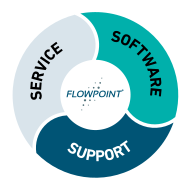
The circular service, software, and support graphic represents an important idea: the relationship continues after commissioning. Service helps maintain the physical system. Software keeps the operating tools current, while support connects customers with people who understand how the pieces work together.
That continuity strengthens accountability. The customer works with one design and engineering team, one supplier, one project management team, one purchase order, one support team, and one warranty framework. So questions don’t need to travel through a chain of disconnected parties before someone takes ownership.
Our water and wastewater case studies show how this coordinated approach applies across bulk water, treatment, storage, wastewater, and waste-management projects. Although the applications differ, each project benefits from clear requirements, coordinated design, controlled production, testing, commissioning, and continued support. Real project results also help new customers see how the framework adapts to different communities and operating conditions.

One Coordinated Path from Concept to Long-Term Operation
The Flowpoint Process does not make every project identical. Instead, it creates a consistent framework for developing a solution around each customer’s specific needs. Discovery defines the challenge, design tests the concept, documentation confirms the plan, and production turns that plan into a working system.
At the same time, custom water management software and coordinated controls connect the equipment to day-to-day administration. Testing reduces uncertainty before and after delivery. Finally, training and long-term support help the customer operate the system with confidence.
That is the value of Turnkey Water and Wastewater Project Delivery: one accountable team working from the first question through the full operating lifecycle. A clear process gives every participant a better understanding of the next decision. If you are developing a municipal water, wastewater, or waste-management project, contact Flowpoint to discuss the requirements, constraints, and next steps.
